
How to Choose an AI Tool: A Practical Guide Before You Subscribe
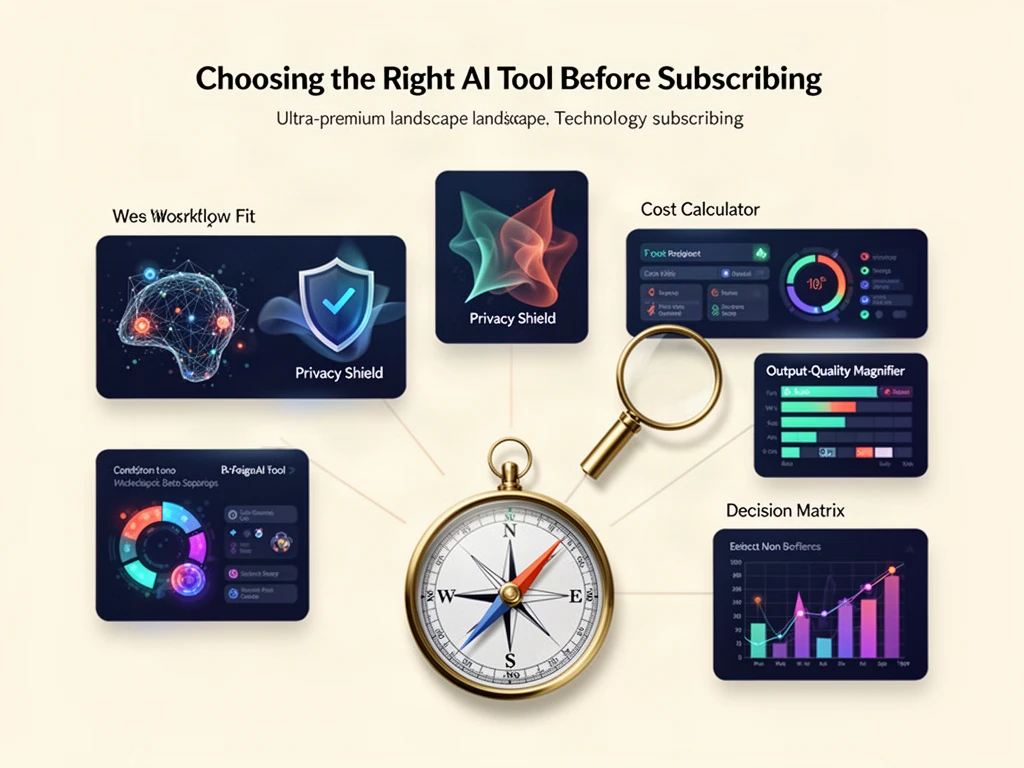

Artificial intelligence promises to save time, simplify everyday tasks, and make difficult work easier. But with so many AI tools competing for attention, choosing the right one can quickly become overwhelming.
One platform promises better writing. Another claims to produce more accurate research. A third offers automation, image generation, or advanced productivity features.
They all look impressive in advertisements. But which one is actually worth your money?
The answer depends less on which AI tool is the most popular and more on what you need it to accomplish.
Before paying for another monthly subscription, use this practical six-step framework to make a more informed decision.
For a worked example across popular assistants, see our ChatGPT, Claude, Gemini and Perplexity comparison, then apply the same tests to your own shortlist. If you already have a shortlist, use our workflow evaluation guide to test the same task with each option and score the full process before subscribing.
1. Start With the Job, Not the Product
One of the biggest mistakes people make when choosing AI software is starting with the brand rather than the problem.
A powerful AI tool is not necessarily the right tool for your workflow.
Start by answering three simple questions:
- What task do I want to complete?
- How frequently will I use this tool?
- What would a successful result look like?
For example, a freelance writer may need help with outlining, editing, and organizing research. A business owner might prioritize customer support, repetitive administrative tasks, or marketing content.
These users may benefit from entirely different AI products.
Practical tip: Write down your three most important use cases before comparing any subscription plans.
2. Build a Shortlist of Two or Three Options
The AI software market is crowded. Comparing ten or fifteen platforms simultaneously can waste more time than it saves.
Instead, select two or three candidates that genuinely match your needs.
Compare them using the following criteria:
- Features relevant to your actual tasks
- Ease of use and learning curve
- Free plan or trial availability
- Monthly and annual subscription costs
- Privacy policies and data handling
- Export options and integration support
- Cancellation conditions and usage limits
Avoid choosing a product solely because influencers recommend it or because its website contains impressive demonstrations.
A well-designed advertisement is not proof that a product will perform well for your particular work.
3. Test Every Tool With the Same Task
This is one of the most important steps.
If you want a fair comparison, give every shortlisted tool the same input, instructions, and evaluation criteria.
Otherwise, your results may reflect differences in the task rather than differences in the software.
A Sample Writing Test
Imagine you want AI assistance with creating business emails.
Give each shortlisted tool the same instruction:
“Write a professional, friendly email requesting an update on an overdue invoice. Keep it below 150 words and avoid aggressive language.”
Evaluate the results based on:
- Accuracy
- Clarity
- Tone
- Formatting
- Amount of editing required
- Time needed to reach a usable result
Repeat the test with several realistic examples.
One impressive response should not determine your purchasing decision.
The comparison illustration in the next section shows how consistent scoring criteria can help you evaluate AI tools fairly.
Caption: Compare like with like: use the same input, instructions and success criteria.
4. Score the Whole Workflow

An AI tool can produce impressive results while still creating more work for you.
For example, a writing assistant may generate content quickly but require extensive fact-checking and rewriting.
An image generator may produce attractive visuals but struggle to maintain consistency across multiple images.
A productivity tool may automate a task but require complicated setup and maintenance.
That is why evaluating the complete workflow matters.
Your Comparison Checklist
Give each tool a score from 1 to 5 for:
- Output quality
- Reliability
- Ease of use
- Editing time required
- Integration with existing software
- Privacy suitability
- Value for money
You can total the scores for an initial comparison, but do not treat them as a scientific ranking.
Some factors, especially privacy requirements and output accuracy, may be more important than the others.
Choose the tool that best supports your actual daily work.
5. Check Privacy Before Uploading Real Work
Convenience should never replace good judgment about personal or business data.
Some AI platforms may process or retain information differently depending on their product, plan, and settings.
Before uploading sensitive content, review:
- Whether your inputs may be used to improve or train models
- Available data retention controls
- Account deletion and data export options
- Security and access controls
- Business or organizational privacy requirements
Avoid uploading confidential customer information, passwords, private financial documents, or sensitive business files unless you have confirmed that the service and its settings are appropriate and authorized for that use.
For further reading, explore the NIST AI Risk Management Framework, which provides a broader framework for thinking about AI risks and trustworthiness.
Privacy requirements and total subscription costs should both be considered before choosing an AI tool.
Caption: A useful subscription must meet your privacy requirements as well as save time.
6. Decide Whether the Cost Is Justified
AI subscription prices can look affordable when presented as small monthly payments.
But several subscriptions can quickly become a significant recurring expense.
Consider an illustrative example:
Suppose an AI subscription costs $20 per month.
Over twelve months, that becomes $240, excluding any taxes or additional usage charges.
Now imagine the tool saves you two hours of useful work every month.
If that time is genuinely worth $15 per hour to you, the estimated monthly benefit would be $30.
In that simplified scenario, the tool might provide reasonable value.
However, time savings do not automatically translate into additional earnings. The actual benefit depends on whether those hours can be put to productive use.
When an AI Subscription May Not Be Worth It
A paid subscription may not make sense when:
- You use the tool only occasionally.
- A free version already meets your needs.
- The outputs require extensive manual corrections.
- Another subscription already provides similar capabilities.
- You cannot identify a meaningful improvement in your workflow.
- The privacy conditions are unsuitable.
Paying for AI software should be a practical decision, not a reaction to marketing pressure or the fear of missing out.
A Simple Decision Rule

Before subscribing, ask yourself:
Does this AI tool consistently make an important task easier, faster, or better without creating unacceptable costs or risks?
If the answer is yes, a subscription may be reasonable.
If the answer is uncertain, keep testing.
And if the answer is no, there is nothing wrong with choosing a free tool or continuing with your existing workflow.
The best AI tool is not necessarily the newest, most expensive, or most heavily advertised platform.
It is the one that solves your actual problem.
Keep Exploring
AI software will continue to evolve, and today’s best option may not remain the best choice forever.
Revisit your subscriptions periodically, compare alternatives when your needs change, and avoid paying for features you do not use.
Explore more practical advice in our AI & Software section and our collection of Guides.
You can also read our Editorial Policy to learn more about our approach to publishing.
Further Reading
For an established reference on managing AI-related risks, visit the National Institute of Standards and Technology’s AI Risk Management Framework.
Final thought: Choose AI tools based on evidence from your own work, not promises from someone else’s advertisement.


