
Base44 Review 2026: Can You Really Build a Professional App Without Writing a Single Line of Code?

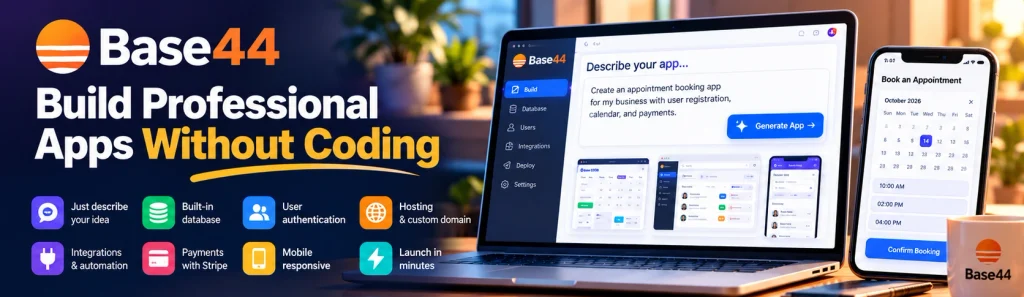
Base44 can make it unusually fast to prototype internal tools and web apps from plain-language instructions, but production use still requires careful checks around permissions, data, integrations, portability and maintenance. This review covers pricing, strengths, risks and ideal use cases.
Updated: October 14, 2026 | BigExclusives Editorial
Disclosure: This article contains an affiliate link. BigExclusives may earn a commission from qualifying purchases, at no additional cost to you.
For a small, concrete test before deployment, follow our Base44 request-tracker prototype workflow and check its permission and data-handling steps. The opening scenario below is illustrative, not a documented customer case or a hands-on Base44 test.
Quick Verdict
Best for: rapid prototypes, internal tools, and no-code users with clearly defined workflows who want to move from an idea to a working first version quickly.
Watch-outs: permissions, sensitive data, integrations, portability, edge cases, security, and long-term maintenance need careful review before production use.
Bottom line: Base44 can reduce the effort needed to prototype an app, but production deployment still requires deliberate testing and governance.
How We Researched This Review
Research basis: Base44’s official app-builder, features, pricing and integrations pages were reviewed alongside its published information about testing and security. Our separate request-tracker workflow is linked where a concrete prototype process is useful.
What we did not do: This review is not a controlled hands-on benchmark of Base44, and it does not claim independent verification of vendor performance or security claims.
Editorial process: Prepared by BigExclusives Editorial under our Review Methodology and Editorial Policy, with vendor claims distinguished from our own practical recommendations.
The App That Nobody Had Time to Build
It was 11:42 PM.
A small business owner was staring at an Excel spreadsheet.
Forty-seven customer requests. Twelve unanswered messages. Three missed appointments. And one increasingly obvious problem.
The business was growing, but its systems weren’t.
Every morning began with checking emails. Every evening ended with updating spreadsheets. Customer information was scattered across messages, documents, and handwritten notes.
The solution seemed obvious: build a simple application where customers could submit requests, check appointments, and receive updates.
There was just one problem.
The business owner didn’t know how to code.
Hiring a developer was an option, but the budget was limited. Learning programming sounded interesting, but running the business already consumed most of the day.
So the idea remained untouched.
Then imagine someone saying:
“What if you could explain your app idea in plain English, and artificial intelligence built the first version for you?”
That sounds like something from a science-fiction movie.
But it is precisely the type of experience Base44 aims to provide.
The question is whether that experience can deliver something genuinely useful—or just another impressive-looking technology demonstration.
What Is Base44?
Base44 is an AI-powered, no-code application-building platform that allows users to create web applications by describing what they want in ordinary language.
Instead of manually writing HTML, CSS, JavaScript, database queries, and backend code, users communicate their requirements to an AI builder.
The platform attempts to turn those instructions into a functional application.
According to its official documentation, Base44 provides:
- AI-powered application generation
- Responsive application interfaces
- Built-in database management
- User registration and authentication
- File and cloud storage
- Backend workflows and automation
- Payment integration capabilities
- Connections to external business applications
- Application hosting and publishing
- Visual editing and customization
- Testing and security-analysis tools
The most important part is that Base44 is not merely designed to create attractive static websites.
It can generate applications that store information, handle user accounts, manage workflows, and perform practical tasks.
For beginners, that represents a potentially significant reduction in the technical knowledge needed to start building software.

Explore Base44 and Start Building for Free →
Wix Acquired Base44 in June 2025 for About $80 Million
Base44 was founded in January 2025 by solo developer Maor Shlomo, without outside funding [https://lerecul.com/en/tested-promises/base44-review-credits-pricing/. On 18 June 2025 — roughly six months later — Wix announced it was acquiring Base44 for approximately $80 million in cash, plus additional performance-based earn-out payments extending to 2029 [https://www.hostingadvice.com/blog/wix-used-to-just-build-websites-now-its-teaching-agents-how-to-run-the-entire-business/. The reported size of those earn-outs varies by source (up to roughly $90 million in Wix shares in some reports), so treat the $80 million upfront figure as confirmed and the total as “plus earn-outs” [https://aidevcases.com/en/cases/base44.
The scale of what followed is unusual for a six-month-old product. By the time Wix reported its third-quarter 2025 results, Base44 had already served more than 2 million users, and by year-end it had reached $100 million in annual recurring revenue [https://www.businessthink.unsw.edu.au/articles/ai-product-strategy-wix-trust-no-code-growth. Wix’s Q1 2026 earnings disclosed ARR growing from about $59 million at acquisition to $100 million within nine months and $150 million by May 2026 [https://aidevcases.com/en/cases/base44. In June 2026 Base44 shipped Base1, its own in-house AI model fine-tuned on an open-source foundation model, reducing its reliance on third-party AI providers [https://www.hostingadvice.com/blog/wix-used-to-just-build-websites-now-its-teaching-agents-how-to-run-the-entire-business/.
What Wix Ownership Means for Longevity
The most common fear about a startup-built app is that the startup disappears and takes your app with it. Wix ownership changes that calculation in both directions.
In Base44’s favour: it is no longer a solo-founder side project. It is owned by a public company with 18 years of operating history, and Wix has made it a visible priority — sending a team of 50 people to work inside Base44 for 19 weeks after the acquisition to apply Wix’s own processes, and featuring Base44 in a Super Bowl LX advertisement on 8 February 2026 [https://www.businessthink.unsw.edu.au/articles/ai-product-strategy-wix-trust-no-code-growth [https://memeburn.com/base44-review/. Base44 continues to operate as a distinct product inside the Wix ecosystem, with access to Wix’s resources, infrastructure, and customer base [https://memeburn.com/base44-review/. For a business app you expect to run for years, that backing is a genuine advantage over any independent vibe-coding startup.
The honest counterweight: ownership is not a guarantee. Wix could change Base44’s pricing, fold it into another product, or deprioritise it — and there is already evidence that pricing moved after the acquisition, with several reviewers noting effective prices rising 15–30% in the period after the deal [https://productos.dev/blog/base44-review-pricing-features-free-tier. The July 2025 authentication bypass — a critical flaw that let anyone register on private apps from a public app ID, fixed within 24 hours of Wiz Research reporting it — is also a reminder that a big owner fixes problems fast but does not prevent them [https://lerecul.com/en/tested-promises/base44-review-credits-pricing/.
The bottom line for readers: Wix ownership makes Base44 a safer bet than a standalone startup for a long-lived app, but it does not remove the lock-in risk in the next section. Judge Base44 on what you can export, not on who owns it.
How Does Base44 Actually Work?
To understand Base44, imagine speaking to a software developer.
You explain your idea.
The developer asks questions, plans the interface, creates a database, builds the necessary functionality, and prepares an application.
Base44 attempts to bring several of those steps into one AI-assisted workflow.
Step 1: Describe Your Idea
You start by explaining what kind of application you want.
For example:
“Build a customer appointment management application for a small consulting business. Customers should be able to register, request appointments, and view their booking status. Administrators should be able to approve or reject appointments and manage customer information.”
The more clearly you explain the requirements, the better the foundation for the generated application.
Step 2: The AI Generates an Initial Application
Base44 interprets your request and begins generating the application’s components.
These can include the user interface, database structures, authentication, and business logic.
For a booking application, this might mean creating a customer registration page, appointment form, and administrator dashboard.
The result is an initial implementation—not proof that every workflow is correct.
Step 3: Review and Improve
Suppose the first version looks attractive, but something is missing.
Maybe administrators need to filter appointments by date.
Perhaps customers should receive a confirmation message.
Or the booking form needs another field.
You can request these changes conversationally.
Instead of rewriting the application manually, you describe what should change and review the result.
Step 4: Test the Application
This is the step beginners must not skip.
Try creating accounts, submitting forms, editing records, and testing permissions.
Check the mobile layout.
Look for broken buttons.
Verify that one customer cannot access another customer’s information.
An application’s appearance is important, but correct behavior is essential.
Step 5: Publish
Base44 includes web hosting and application-publishing features.
After reviewing and testing an application, users can publish it and share the resulting web address.
Custom domains and additional capabilities depend on the selected plan.
The process can be considerably more approachable than configuring a development environment from scratch.
But publishing software is only the beginning of maintaining it.
Seven Features That Make Base44 Worth Exploring
1. Build Applications Using Natural Language
The most recognizable feature is the conversational builder.
People can describe what they want without memorizing programming syntax.
This is especially interesting for entrepreneurs who understand their business requirements but don’t know how to implement them technically.
A restaurant owner understands reservations.
A teacher understands class schedules.
A consultant understands client management.
Base44 offers a way to translate some of that practical knowledge into an initial application.
2. Built-In Databases
Many basic web tools become much more valuable when they can remember information.
Consider a simple to-do list.
A static version might display tasks without saving them.
A database-connected version can store tasks, deadlines, owners, and completion status.
Base44 includes database functionality that supports these types of workflows.
This saves users from having to configure a separate database service at the beginning of every project.
However, database design and access permissions still require review.
3. User Accounts and Authentication
Imagine creating a client portal.
Different customers must be able to log in and see their own information.
Administrators may need broader access.
Base44 supports authentication and user management.
The platform can provide the infrastructure, but the application owner must still verify which users can access which information.
4. External Integrations
A useful business application rarely exists in isolation.
It may need to communicate with email, spreadsheets, calendars, payment services, or customer-management software.
Base44 provides integrations with several business platforms, including supported connections involving Google services, Slack, Salesforce, Zapier, and others.
Some integrations and advanced capabilities have plan restrictions.
Before designing an app around a particular integration, confirm its availability and requirements.
5. Payment Functionality
Base44 supports payment-related functionality through integrations such as Stripe.
This could be relevant to businesses creating subscription services or applications that collect payments.
But payment acceptance is not simply a matter of adding a button.
Businesses must also consider payment-provider eligibility, supported countries, fees, refunds, taxes, and applicable regulations.
6. Visual Customization
AI-generated designs don’t always match a company’s brand.
Base44 provides visual editing tools for changing elements such as typography, colors, spacing, and layout.
This lets users refine an application without making every design adjustment through code.
A polished design still requires judgment, especially around readability, navigation, and accessibility.
7. Testing, Verification, and Security Scanning
One of the most consequential parts of Base44’s evolving feature set is its support for application testing.
In June 2026, Base44 announced Verification, a Testing Agent, and Security Scan.
These tools are designed to help review generated code, exercise application workflows, and identify potential security-related problems.
That is a meaningful development because a generated application can look complete while still containing functional mistakes.
However, automated testing and scanning cannot guarantee that an application is secure or free from defects.
For important systems, independent review remains necessary.
What Can You Actually Build With Base44?
The range of potential applications is one of the platform’s strongest attractions.
Here are six realistic project ideas worth investigating.
A Customer Management Portal
A small business could create a portal that stores customer requests, tracks their status, and helps employees coordinate responses. Our Base44 client portal guide explains how to plan client logins, privacy checks, data ownership and realistic operating costs.
Start with fictional customer records and test access permissions before connecting real information.
An Appointment Booking System
A consultant, tutor, or service provider could experiment with an application that accepts booking requests and displays appointment schedules.
Before launch, verify time zones, duplicate bookings, cancellations, and confirmation messages.
An Expense Tracking Tool
A freelancer might create an application to categorize expenses, record payments, and review monthly totals.
Financial calculations and exports must be tested carefully before the results are used for accounting or tax decisions.
An Internal Project Dashboard
A team could build a dashboard showing assignments, deadlines, statuses, and project notes.
This is particularly useful when a general-purpose project management system contains more complexity than a small team needs.
A Digital Resource Directory
Creators may want a searchable directory of articles, tools, downloads, or educational resources.
An AI builder can help develop search, filtering, and administrative functionality.
A Subscription-Based Web Service
More ambitious users may explore a focused SaaS product offering a useful digital service.
Such projects require careful attention to authentication, payments, customer support, ongoing costs, and reliability.
The best first application is not necessarily the most ambitious one. It is the smallest useful application you can test properly.
Base44 Pricing in 2026: How Much Does It Cost?
Base44 offers a free plan and several paid subscriptions.
Its official pricing page currently lists the following:
| Plan | Monthly billing | Annual billing, monthly equivalent |
|---|---|---|
| Free | $0 | $0 |
| Starter | $20 | $16 |
| Builder | $50 | $40 |
| Pro | $100 | $80 |
| Elite | $200 | $160 |
The annual prices are advertised monthly equivalents; annual subscriptions are charged for the annual period.
The monthly message and integration credit allowances are:
| Plan | Message credits | Integration credits |
|---|---|---|
| Free | 25 | 100 |
| Starter | 100 | 2,000 |
| Builder | 250 | 10,000 |
| Pro | 500 | 20,000 |
| Elite | 1,200 | 50,000 |
Prices checked November 1, 2026. Pricing, features, and allowances can change. Verify the official pricing page before purchasing.
What Are Message Credits?
Message credits represent an allowance for AI-building activity.
When you ask the builder to generate or modify functionality, your work can consume credits.
The exact amount depends on the action and the model involved.
This matters because complex projects may require repeated revisions.
What Are Integration Credits?
Integration credits cover supported actions performed through the application and its integrations.
A project using multiple automated workflows may consume more resources than a simple static application.
The distinction matters when deciding how much a live application may cost to operate.
Which Plan Should Beginners Choose?
Start with Free.
The free plan allows users to explore the builder and create a small number of applications.
Avoid subscribing solely because a promotional demonstration looks impressive.
First, create a project and determine whether the platform can deliver the functionality you need.
Then consider upgrading when limits or required features make the benefit clear.
For details, see Base44’s official pricing page.
A Worked Example: How Fast Message and Integration Credits Burn
Base44 charges on two separate meters, and confusing them is the fastest way to get an unexpected bill. The allowances below are from this review’s pricing section, checked 1 November 2026 — verify them on Base44’s pricing page before buying, as they can change.
| Plan | Price (annual billing) | Message credits / month | Integration credits / month |
|---|---|---|---|
| Free | $0 | 25 | 100 |
| Starter | $16 | 100 | 2,000 |
| Builder | $40 | 250 | 10,000 |
| Pro | $80 | 500 | 20,000 |
| Elite | $160 | 1,200 | 50,000 |
Message credits pay for AI building activity — each time you ask the builder to generate or modify functionality. Base44 does not publish a fixed per-action price list: the exact amount depends on the action and the model involved, so the example below is a budgeting illustration with its assumptions stated, not a quote.
Worked example — building a small booking app on Builder ($40/month, 250 message credits). Assume one message credit per prompt, which is the simplest case. A first build of a real app typically takes 15–25 prompts of generation, correction, and refinement. That is roughly a tenth of the monthly allowance for the initial build. But iteration is where the meter runs: fixing a bug usually takes 3–5 prompts per bug, a design revision 5–10, and a new feature 10–20. Two weeks of active iteration at 10 prompts a day is 140 credits — more than half the Builder allowance — and a bad week of debugging can consume the rest. On the Free plan (25 message credits), the same two weeks of work is impossible: the allowance is gone in two or three days.
Worked example — running the finished app. Integration credits pay for actions performed through the live application and its integrations — automated workflows, runtime AI calls, emails, and file uploads. On Builder you get 10,000 a month. If each automated action costs one integration credit (again, an assumption — Base44 does not publish the per-action rate), that is about 333 actions a day. A booking app that sends a confirmation email and a calendar invite per booking, plus a daily summary, uses roughly 3 integration credits per booking: 10,000 credits cover about 3,300 bookings a month. That sounds generous — until an automation loop misfires and burns hundreds of credits an hour. The practical rule is to watch the integration meter in the first month, because a live app’s running cost is invisible until it is not.
Three budgeting rules:
- Start on Free, but expect to pay from the first real project. 25 message credits are a demo, not a build budget.
- Builder is the honest starting point for a real app — 250 message credits plus 10,000 integration credits, and GitHub export, which Free and Starter do not include.
- Treat credit burn as a feature of the pricing, not a bug. Every revision costs credits, so write precise prompts, batch your change requests, and test before asking for the next round — the cheapest credit is the one you never spend.
What Are the Disadvantages of Base44?
This is where a serious review must move beyond attractive interfaces and exciting product demonstrations.
Base44 offers interesting capabilities, but it also introduces important trade-offs.
1. AI Can Misunderstand Requirements
Suppose you request a booking application that should prevent overlapping appointments.
The generated interface looks perfect.
But during testing, you discover that two customers can book the same time slot.
This illustrates why AI-generated software must be tested against real business requirements.
A convincing interface does not guarantee correct logic.
2. Complex Projects Can Consume Credits
A simple application might require relatively few instructions.
A more ambitious product may need many iterations.
Design changes, new workflows, error corrections, and additional functionality can increase credit consumption.
Predicting your total cost before building can therefore be difficult.
3. Security Requires More Than a Login Page
Having authentication does not automatically mean sensitive information is properly protected.
Consider an application storing customer records.
You must verify that users cannot access information through unintended pages, queries, or permissions.
You must also understand data retention, access controls, backups, and regulatory responsibilities.
For sensitive or regulated applications, professional security review may be necessary.
4. Large Applications May Require Developers
AI tools can accelerate application creation.
But complicated systems may still need experienced engineers.
Advanced integrations, unusual business logic, performance optimization, and infrastructure migration can all create challenges that conversational instructions alone may not resolve.
5. Code Export Doesn’t Eliminate Every Dependency
Base44 advertises source-code ownership and GitHub integration.
That’s encouraging for people concerned about portability.
However, owning exported code is not automatically the same as being able to operate the complete system elsewhere without additional work.
Before depending on the platform for a critical project, investigate how databases, hosting, authentication, integrations, and operational services would be migrated.
6. Your Product Still Needs Customers
This may be the most overlooked limitation.
Creating an application does not establish demand for it.
A beautifully designed service with no users is still a product without a proven market.
Before spending heavily, identify a real customer problem, validate interest, and determine whether users would pay for the solution.
Base44 can make building easier. It cannot guarantee that what you build will become a successful business.
Backend Lock-In: What You Can and Cannot Take With You
This is the most important section in this review if you plan to build anything you might one day move. Base44’s own pricing page says: “Yes. You own everything you build on Base44: your code, your data, your users. Two-way GitHub sync exports the full source code to your own repo at any time. Nothing is locked to the platform.” That claim and the technical reality do not match — and the gap is the whole story [https://hyperlambda.dev/blog/there-is-a-discord-called-base44-refugees.
What actually exports: the frontend. Base44’s two-way GitHub sync exports the frontend source code — a React application — to your own repository, where you can read it, edit it, and commit it. GitHub export requires the Builder plan or higher ($40/month on annual billing, $50 month-to-month) [https://www.nocodeappguide.com/reviews/base44.html [https://hyperlambda.dev/base44-alternative.
What does not export: the backend. The database is Base44’s, authentication is Base44’s, backend functions run as Deno serverless functions inside Base44’s runtime, and custom integrations are proxied through Base44’s backend — in Base44’s own documentation’s words, “so credentials are never exposed to the frontend” [https://hyperlambda.dev/blog/there-is-a-discord-called-base44-refugees. Every one of those is reached from your exported code through the Base44 SDK. The exported repository therefore does not run on its own: cancel your subscription and what you own is a folder of code that calls an API you no longer have access to [https://hyperlambda.dev/blog/there-is-a-discord-called-base44-refugees.
What this means in practice:
- Internal tools and prototypes: lock-in barely matters. Build it, use it, and if you ever leave, rebuild it — the app was cheap to create in the first place.
- A production business app: lock-in matters a lot. Leaving does not mean moving; it means rebuilding the backend somewhere else and repointing the frontend at it. There is even a paid migration service advertising more than a hundred completed Base44 migrations, whose pitch is recovering “the code Base44 keeps hidden” [https://hyperlambda.dev/base44-alternative.
- Compared with rivals: Lovable, Bolt, and Replit give you exportable code that runs locally with standard setup commands, because their backends are standard Supabase or similar services. Base44’s backend is proprietary and cannot be self-hosted [https://www.bworlds.co/learn/base44-vs-bolt/.
Before you commit to Base44 for a production app, decide your exit in advance: keep a regular export of your data, document your database schema outside Base44, and assume that leaving will cost you a rebuild of the backend, not a migration.
Tenzai: Optional Live Penetration Testing (and What It Does Not Do)
Base44’s security story has a notable add-on: optional live penetration testing from Tenzai, an AI-native cybersecurity company whose autonomous agents attack a live application to find exploitable vulnerabilities [https://www.linkedin.com/company/tenzai-inc?trk=similar-pages. Tenzai’s testing was added for Builder and higher plans, and it needs its own separate Tenzai account and billing — it is not included in the Base44 subscription price [https://aibuildercompare.com/reviews/base44.
What Tenzai does is different from a code scan: it runs real attacks against the live app, on top of the code scanning your team already runs [https://www.linkedin.com/company/tenzai-inc?trk=similar-pages. In one published test, Tenzai built the same three apps with five different models on Base44 and ran its AI hacker against all 15 builds, uncovering 254 vulnerabilities across them — and finding that Base44’s own Base1 model produced the strongest results, as the only model with zero high- or critical-severity findings [https://www.tenzai.com/blog/five-models-walk-into-an-app-builder-security-gets-interesting.
Two honest limits. First, a penetration test does not make an app automatically safe: you still need to verify permissions, access controls, and application behaviour yourself, and a test result is a snapshot, not a guarantee [https://aibuildercompare.com/reviews/base44. Second, the separate billing means the real cost of a security-reviewed Base44 app is the Base44 plan plus the Tenzai bill — check Tenzai’s current pricing before budgeting for it. For an internal tool, Tenzai is optional. For an app handling customer data or payments, it is the cheapest credible way to find out whether your AI-generated authentication actually works.
Base44 vs Traditional App Development
| Factor | Base44 | Traditional development |
|---|---|---|
| Technical starting point | Natural-language instructions | Design and programming |
| Initial learning curve | Often lower | Usually higher |
| Prototype creation | AI-assisted | Developer-led |
| Backend setup | Integrated platform features | Custom or separately configured |
| Design flexibility | Visual tools and generated code | Potentially extensive |
| Unusual requirements | May need workarounds | Greater architectural control |
| Security responsibility | Human review still needed | Human review still needed |
| Costs | Subscription and usage-based limits | Development, infrastructure, and maintenance |
| Long-term portability | Requires planning | Depends on architecture and services |
Traditional development provides deep control but generally requires more technical resources.
Base44 can reduce the effort required to produce an initial application, particularly for common business workflows.
The better approach depends on the complexity and importance of the software being created.
Is Base44 Better Than Other AI App Builders?
Base44 operates in a growing market that includes tools such as Lovable, Bolt, Replit, and other AI-assisted development platforms.
Rather than declare a universal winner, compare them using the same project.
A useful comparison should examine:
- How accurately each builder follows instructions
- Whether the application actually works
- Database and authentication capabilities
- Code editing and export options
- Integration support
- Mobile experience
- Testing and security features
- Ongoing cost
- Difficulty of fixing unexpected problems
A more affordable subscription is not necessarily better if it takes significantly more work to achieve the same reliable result.
The strongest builder is the one that meets your actual requirements at a sustainable cost. For a repeatable way to compare builders on the same task, privacy, cost and correction effort, use our AI-tool evaluation guide.
Can You Make Money With Apps Built on Base44?
Potentially, yes.
But earnings depend on the quality and usefulness of the application, competition, marketing, pricing, and customer demand.
Some possible business models include:
Subscription software: Charge customers a recurring fee for access to a specialized tool.
Custom business applications: Build tailored systems for organizations that need straightforward digital workflows.
Paid directories: Offer a carefully maintained database of valuable information or professional resources.
Booking platforms: Help providers manage customer reservations or requests.
Internal software services: Create tools for businesses that want to replace repetitive spreadsheet processes.
Every model has challenges.
A subscription application needs ongoing support.
A directory requires accurate, updated information.
A client project creates maintenance obligations.
A payment-based product introduces financial and compliance responsibilities.
No application builder can eliminate these realities.
Focus on finding a real problem before trying to monetize a solution.
A Practical Seven-Day Experiment Before You Subscribe
If you’re curious about Base44, here’s a sensible way to evaluate it.
Day 1 — Choose the Problem
Identify one specific task an application should accomplish.
Write down who will use it and why it matters.
Day 2 — Build a Small Prototype
Describe the required features to Base44.
Use sample information, not confidential customer data.
Day 3 — Test Basic Functionality
Submit forms, create records, edit information, and explore the application.
Record every issue.
Day 4 — Review the Design
Check navigation, readability, spacing, and mobile layouts.
Make only the changes that improve usability.
Day 5 — Test User Permissions
Create different test accounts.
Check whether each account can access only the information intended for it.
Day 6 — Review Credits and Limitations
Inspect how much of your allowance was consumed.
List features that remain unfinished and estimate the additional work required.
Day 7 — Make Your Decision
Ask yourself:
Did the platform create something useful?
How much correction was needed?
Can I maintain the result?
Would paying for the next plan solve a real limitation?
If you can answer those questions positively, upgrading may make sense.
If not, keep experimenting or consider an alternative.
Is Base44 Worth It in 2026?
Our editorial assessment is that Base44 is a compelling option to evaluate for beginners, entrepreneurs, and teams interested in building focused applications without beginning from traditional programming.
Its combination of natural-language creation, databases, authentication, integrations, and hosting gives it a broad set of capabilities.
The availability of a free plan makes initial experimentation more accessible.
The important qualifications are equally clear.
Generated applications can contain errors.
Complex projects may consume substantial credits.
Security and data permissions must be verified.
And building a product is only one part of operating a successful digital business.
This assessment is based on published platform capabilities and documentation, not an independent hands-on performance benchmark.
For someone planning a modest internal tool or proof of concept, Base44 is worth considering.
For high-risk systems or highly customized products, the need for experienced engineering and independent testing remains.
Frequently Asked Questions
Is Base44 completely free?
Base44 offers a free plan with limited monthly message and integration credits. Paid plans provide larger allowances and additional capabilities.
Can a beginner use Base44 without programming knowledge?
Yes. Base44 is designed to let users describe applications using natural-language instructions. Some advanced requirements may still need technical help.
Can Base44 create a professional website?
Yes. Base44 supports websites and web applications, although the best choice depends on the site’s requirements.
Does Base44 support custom domains?
Yes, custom-domain functionality is available on eligible paid plans.
Can Base44 create mobile applications?
Base44 supports mobile-responsive applications. Its documentation also describes tooling that can help prepare and submit apps to the Apple App Store and Google Play on eligible plans. App-store submission and approval remain separate requirements.
Can I export my Base44 application?
Base44 advertises code export and GitHub integration. Check the plan requirements and evaluate any external services that would need to be migrated.
Is Base44 suitable for a startup?
It can be useful for prototypes, initial products, and focused business applications. Suitability for a particular startup depends on technical requirements, costs, reliability, and growth plans.
How long does it take to build an app with Base44?
Initial screens or prototypes may be generated quickly, but completion time depends on complexity and the amount of testing, refinement, and integration required. No fixed timeline applies to every project.
Does Base44 guarantee my app will be secure?
No software-building platform can guarantee that every custom application is completely secure. Application owners should test permissions, review sensitive workflows, and seek specialist advice where appropriate.
Final Verdict: The Next Big Idea Might Begin With a Sentence
Remember the small business owner staring at that spreadsheet?
The appointments were still waiting.
The customer requests were still scattered.
The problem hadn’t disappeared.
But the path toward solving it had changed.
Instead of immediately hiring a development team or spending months learning programming, the owner could begin with something much simpler.
A sentence.
“Build an appointment-management app for my business.”
An AI builder might transform that request into a useful first version.
Would everything work perfectly?
Probably not.
Would the application still need testing, corrections, and careful management?
Absolutely.
But there is something powerful about moving from an idea to a functioning prototype without first overcoming every traditional technical barrier.
That is the genuine promise of Base44.
Not that artificial intelligence can magically create a successful business.
Not that programming knowledge has become worthless.
And certainly not that professional developers are no longer necessary.
The real opportunity is that more people can experiment with software ideas that once seemed beyond their reach.
The future of application development may not begin with knowing how to write code. It may begin with knowing exactly what problem is worth solving.
The decision is yours.
If you would rather work with code than a no-code builder, our ZCode coding guide walks through a safer seven-step ZCode workflow with GLM-5.3.
Explore Base44 — Start Building Your App →
Editorial Transparency
This is an independent, research-based product overview. BigExclusives has not conducted a controlled hands-on benchmark of Base44 for this review. Product capabilities and pricing were checked against official documentation on October 14, 2026. Readers should verify current terms before making a purchase. If you are deciding between a managed no-code app platform and a coding agent, see our Base44 vs Z.ai ZCode comparison.
This article contains an affiliate link. We may receive compensation from qualifying purchases, at no additional cost to you.


